

When The Environment Shifts: How Payroll Leaders Are Strengthening Confidence in a Tighter Economy
Lessons, Signals And Strategies For The Next Phase Of Payroll Leadership
Payroll rarely gets quieter when the economy tightens. If anything, the opposite happens.
As cost pressures build, scrutiny sharpens. Headcount is questioned. Systems are examined. Decisions that once sat comfortably within operational boundaries begin to attract executive attention. Through it all, payroll remains one of the few functions that cannot afford to falter.
For payroll leaders, this is a familiar pattern, but the current environment carries a distinct edge. Cost of living pressures, industrial relations reform, and a workforce more focused than ever on what lands in their bank account have combined to push payroll beyond its traditional boundaries. Getting pay right is now a visible signal of organisational integrity.
This paper explores how payroll leaders are responding, where pressure is building, what signals are emerging and how organisations are strengthening confidence in payroll as expectations rise.
The Regulatory Environment Is Not Easing
The introduction of federal wage theft laws has materially changed the consequences of payroll failure in Australia. What was once largely treated as a civil matter now carries the potential for criminal liability. This is not just a technical adjustment; it represents a fundamental shift in how payroll risk is viewed.
Alongside this, the proposed move to Payday Super introduces a different kind of pressure. Shifting from periodic superannuation contributions to payments aligned with each pay cycle tightens the connection between payroll accuracy, cash flow and reporting. It reduces the margin for delay and increases the importance of getting each pay run right the first time. It also places greater emphasis on system capability, particularly where current processes rely on batching, adjustments or manual intervention.
Enforcement activity continues to surface systemic underpayment issues across industries. These are rarely isolated incidents; more often, they stem from complexity, legacy processes and systems that have not kept pace with regulatory change. What stands out is not a lack of effort, but a lack of defensibility. Organisations believed they were doing the right thing but could not demonstrate it with sufficient clarity when challenged. It is no longer enough to get payroll mostly right. Organisations are expected to show how and why it is right, with evidence that holds up under scrutiny.
What Economic Pressure Actually Does To Payroll Teams
Inside payroll, the impact of economic tightening is more layered than budget conversations suggest. A consistent pattern is the expectation to absorb additional complexity without increased resources. In some cases, teams are leaner, but the work is not. This is where risk begins to accumulate.
Reconciliation cycles tighten. Review processes compress. Tasks that would ideally involve a second set of eyes are completed once, with the intention of revisiting them later. That second pass does not always happen.
Reliance on key individuals also increases. Many payroll functions depend on one person who understands the intricacies of a particular award, agreement or system configuration better than anyone else. In a stable environment, that knowledge is invaluable; in a constrained one, it becomes a vulnerability. If that individual is unavailable, even temporarily, the impact is immediate, not just operationally, but in confidence.
There is also a behavioural shift worth noting. Employees are paying closer attention to their pay, than they have in the past. Financial pressure sharpens focus. Discrepancies are identified more quickly and escalated more readily. What might once have been resolved quietly can now become a broader issue in a much shorter time.
The Signals Worth Watching
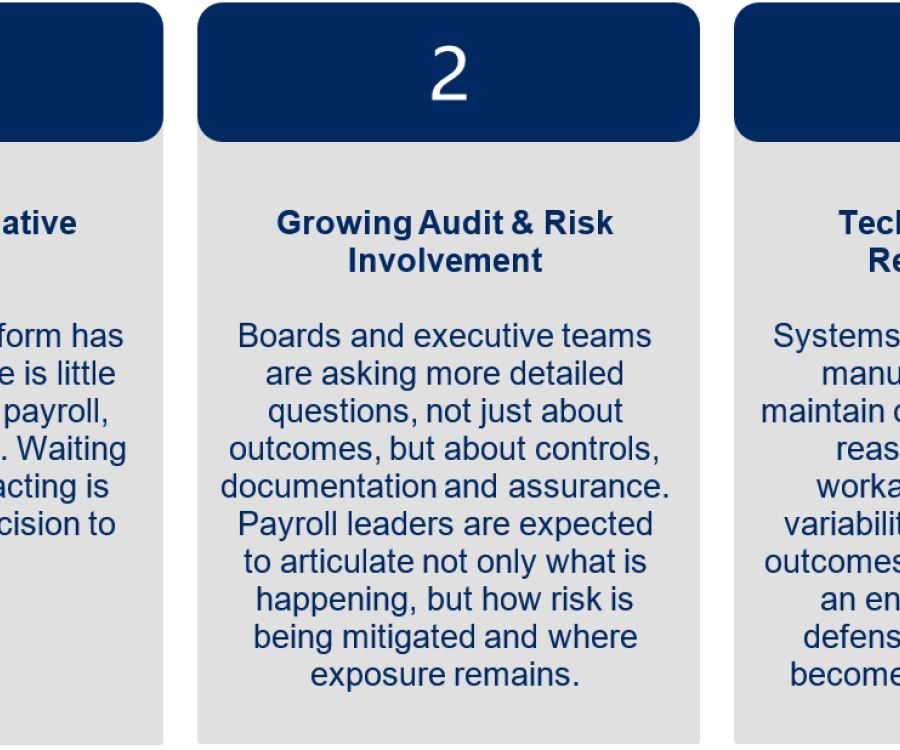
Experienced payroll leaders spend less time reacting to individual issues and more time reading the environment around them. In the current climate, several signals are emerging.
Where Resilience Is Being Built
Clear patterns are emerging in how leading payroll teams are responding.
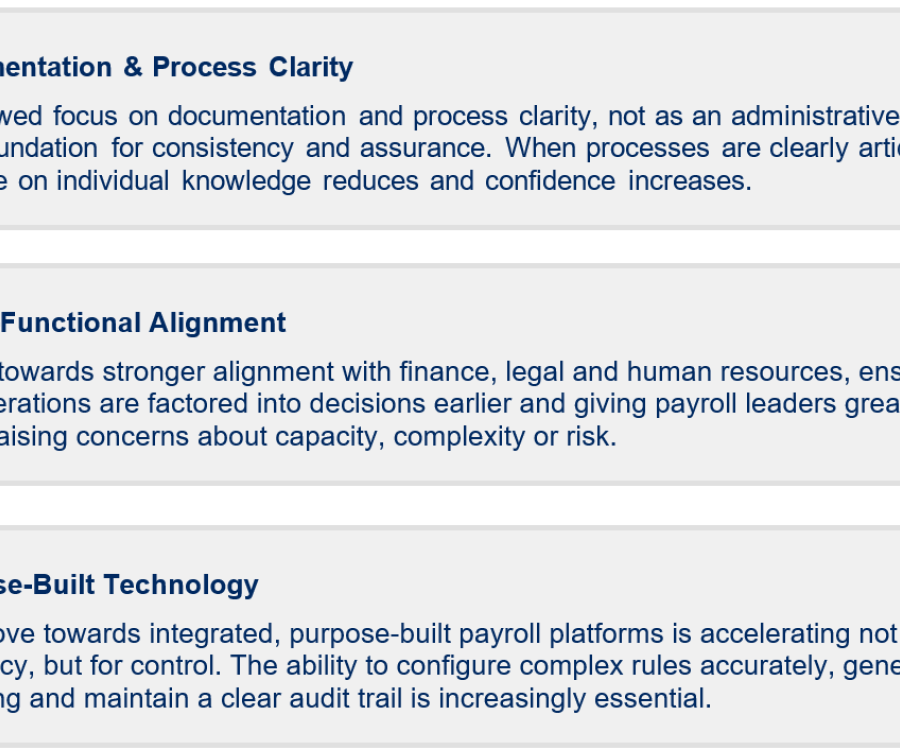
Platforms that are designed for legislative complexity and can adapt as requirements evolve, are becoming critical to resilience.
Leading From The Front
Payroll leaders carry responsibility for outcomes influenced by systems, processes and data beyond their direct control. What is changing is the level of visibility attached to that responsibility. Payroll issues are no longer contained within the function; they reach executive teams, boards and sometimes the public domain. Authority and resourcing do not always increase at the same pace, creating a tension many payroll leaders will recognise: accountability without full control.
The organisations navigating this most effectively recognise payroll leadership as strategic. They invest in it, accordingly, provide access to the right systems and ensure alignment across functions.
The environment will continue to shift. Legislative change will persist. Economic pressure will fluctuate. Workforce expectations will evolve. What remains constant is the need for payroll to be stable, trusted and defensible. The leaders strengthening those foundations now, through clearer processes, stronger governance and more resilient systems, are positioning their organisations to manage whatever comes next with confidence.