The Payroll Knowledge Crisis: How Australian Organisations Can Reduce Payroll Continuity, Compliance and Workforce Risk
Why Payroll Resilience Is Now a Leadership Priority
There is a version of every organisation's worst week that has nothing to do with revenue, reputation or competitors. It starts with a phone call. Someone in payroll is not coming back, not this week, maybe not ever, and suddenly the people who run the business realise that the only person who understood how payroll actually worked has walked out the door with it.
This is payroll continuity risk in its rawest form and it is more common than most leadership teams assume. Payroll is one of the few functions where failure is immediate and personal. Get it wrong and employees know within hours. Get it wrong repeatedly and trust erodes fast, both with staff and regulators. Yet for something this critical, payroll capability often rests on remarkably thin ground: a handful of people, sometimes just one, carrying knowledge that has never been formally transferred.
That single point of failure is no longer a back-office inconvenience. It is a leadership issue and it is time it was treated like one.
The Single-Person Payroll Risk
In small and mid-sized organisations, payroll has a habit of becoming one person's domain. Not by design, but by drift. Someone learns the system, builds the workarounds, memorises the exceptions and, over time, becomes the only one who can run the process end to end. No one hands them that responsibility deliberately. It simply accumulates until the organisation is more dependent on them than anyone realises.
It works, until it doesn't. An illness, a resignation or a retirement can make continuity disappear overnight. Legislation has not stood still while that knowledge accumulated, which means a replacement cannot simply be slotted in. They need to be trained and training takes time the organisation rarely has. Recruitment adds further delay, particularly when the role demands specific system and compliance experience that few candidates can offer on day one. What began as a staffing gap becomes a payroll failure and payroll failures do not stay quiet.
The lesson is simple and uncomfortable: a resourcing problem in payroll is never just a resourcing problem. It is a business continuity problem waiting for a trigger. Most organisations only discover how exposed they are after that trigger has already been pulled.
Why Larger Payroll Teams Still Face Knowledge Risk
Larger payroll teams look, on paper, like the answer. More people, less dependency. But headcount is not the same as resilience and treating the two as interchangeable is where many organisations go wrong.
Inside sizeable payroll functions, expertise still pools around individuals. One person understands the enterprise agreement inside out, including the interpretations and precedents that never made it into any manual. Another is the only one who truly knows the integration between payroll and rostering and what happens when it breaks. A third carries the institutional memory of every exception case the team has handled, including the judgement calls that policy alone could never cover.
This is payroll capability risk in its quietest form. The team is stable, the org chart looks healthy, yet the actual expertise is concentrated in a small number of minds.
Turnover proves this the hard way. A team can lose none of its size and all of its depth in a single resignation. The org chart survives - the capability does not. Without deliberate payroll succession planning and knowledge transfer, that gap simply waits for the next departure to expose it.
Why Payroll Knowledge Risk Is Growing
Payroll has always required specialist knowledge, but the environment in which that knowledge is applied has become more demanding. Several pressures are converging, increasing both the value of experienced payroll capability and the consequences when it is lost.
Payday Super is reshaping obligations and timelines, placing greater pressure on payroll processes, data accuracy and the timely resolution of errors. At the same time, payroll underpayments continue to attract scrutiny, bringing the quality of payroll governance, controls and decision-making into sharper focus.
Awards and enterprise agreements add another layer of complexity. Their application often depends on interpretations, precedents and organisation-specific knowledge developed over many years. When that knowledge sits with a small number of experienced employees, it can be difficult to document fully and even harder to replace quickly.
The workforce challenge is compounding the risk. Experienced payroll professionals are becoming harder to recruit, while many long-serving practitioners are approaching retirement. Organisations may find themselves competing for scarce expertise at the same time as critical knowledge is leaving the workforce.
Payroll knowledge is becoming more valuable at precisely the point when it is becoming harder to retain, transfer and replace
Payroll Continuity Planning: The Response Taking Shape
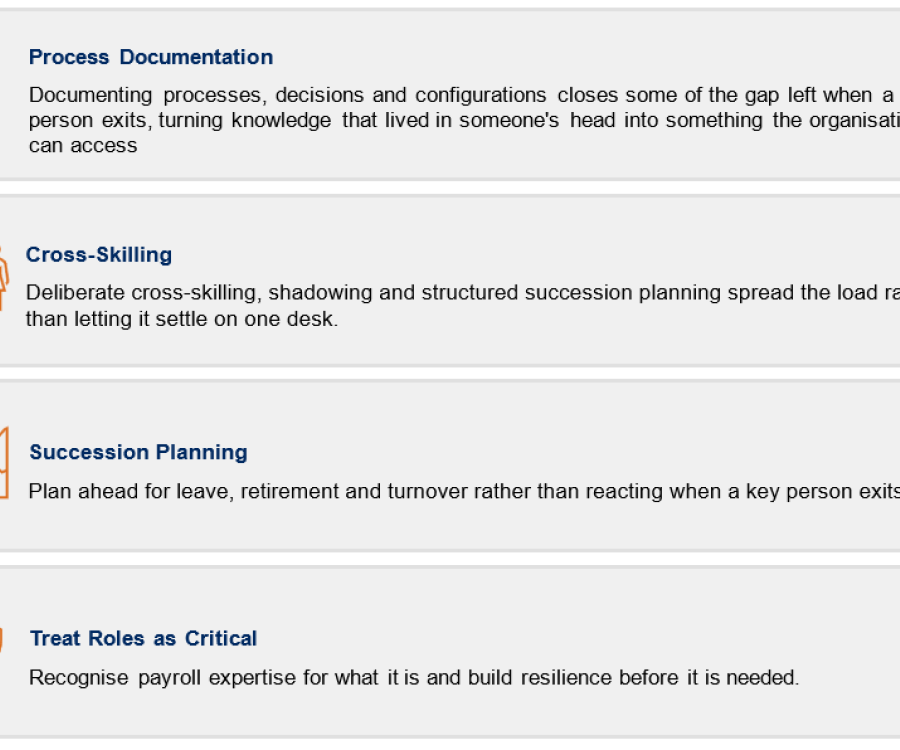
Most organisations have a business continuity plan for their systems, their premises and even their supply chains. Far fewer have one for the knowledge sitting inside their payroll function. That gap is starting to draw attention from leadership teams that have watched the risk build without a plan to match it.
Outsourcing as a Payroll Resilience Strategy
This is where outsourcing is undergoing a quiet reinvention. It used to be framed almost entirely as a cost conversation, a way to trim overhead and simplify a function seen as administrative rather than strategic. Increasingly, it is being framed as a resilience conversation instead, driven less by budget pressure and more by a hard look at where the organisation is genuinely exposed.
Bringing in specialist expertise reduces how much any single individual has to carry, spreading knowledge across a team built specifically to hold it. A specialist provider does not depend on one person being available, and that changes the risk profile of the function. Peak periods, absences and sudden workload spikes become easier to absorb without scrambling for temporary cover, while the pressure to recruit from a shrinking pool of experienced payroll talent begins to ease.
For organisations that want to retain internal payroll capability, co-sourcing can provide targeted resilience during employee absences, major projects, peak processing periods or periods of increased demand. Fully managed payroll offers the strongest continuity model for organisations seeking to reduce operational dependency, strengthen access to payroll expertise and remove the day-to-day burden of payroll processing from the internal team.
It is not about stepping away from payroll or losing sight of it. It is about removing the operational dependency on any one person being available, well and still employed, while giving the organisation confidence that payroll will continue to run effectively, whatever the org chart happens to say.
The Bottom Line
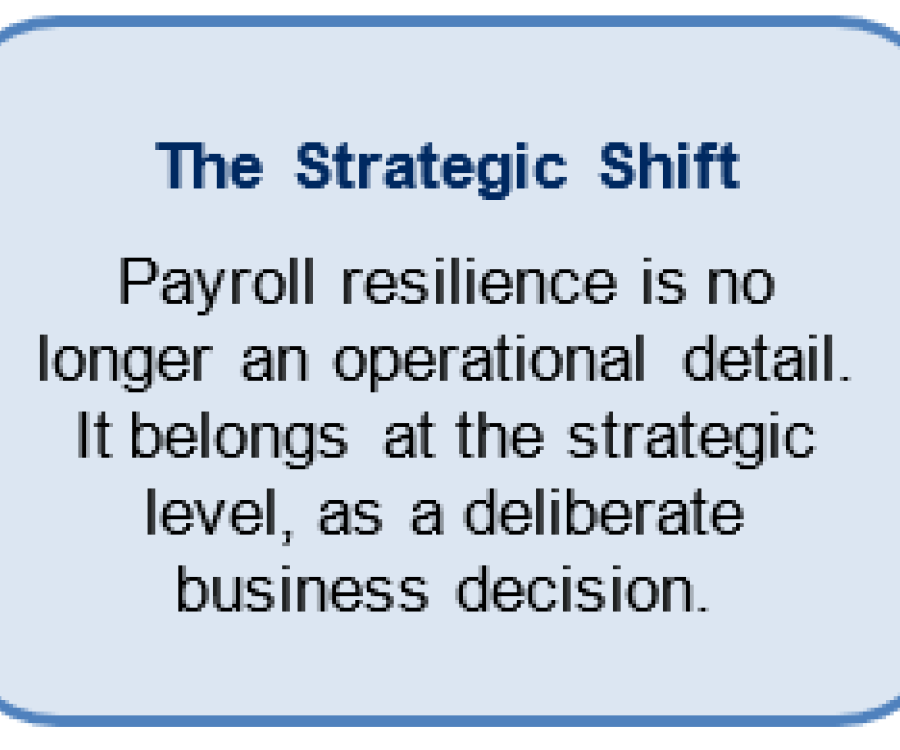
Payroll resilience has moved from an operational detail to a strategic question, and it deserves a place in that conversation at the highest level. The real risk was never simply about losing people. It is about losing the knowledge those people carried, quietly, without anyone noticing until the moment it was gone and impossible to retrieve.
Organisations need a model for maintaining payroll capability that does not rely on hope or on one person's continued goodwill and good health. For a growing number, that model includes outsourced or co-sourced payroll, not as a cost play, but as a deliberate part of how the business manages payroll continuity risk and protects itself against any exposure it may be carrying.