

The Payroll Evidence Standard: Why Paying Correctly Isn’t Enough
Australian payroll now carries an executive-level test: can every pay decision be explained, traced and defended? As scrutiny intensifies, the quality of payroll evidence is becoming a defining measure of organisational control and accountability.
For most of its history, Australian payroll has been measured by one question: did everyone get paid the right amount, on time? It remains a fair and difficult question. Yet the ground has shifted. A second question now sits beside the first: can you prove it?

Since 1 January 2025, intentional underpayment of wages or entitlements has been a criminal offence under the Fair Work Act. Because the offence turns on intentional conduct, the evidence around pay decisions, what was recorded, when action was taken and how errors were handled, matters more than ever.
Payday Super adds another layer. From 1 July 2026, employers must pay superannuation guarantee contributions on payday, with contributions generally required to reach an employee’s fund within seven business days. The Australian Taxation Office has set out a specific compliance approach for the first year. The message for payroll professionals is broader than just moving money faster. Payroll increasingly needs to demonstrate not only that an employee was paid correctly, but how the organisation knows it.
The Shift from Payment to Proof
These developments point to a clear pattern. Payroll has moved from a payment discipline to an evidence discipline. The pay run is still the visible output. The durable asset is the record that surrounds it: the calculation trail, the approvals, the interpretation of an award or agreement, the source data and the correction made weeks later, together with the reasoning behind it.
Take a routine question. Why did an employee receive a particular allowance? A payroll professional may know the answer at once. But could someone else, months later, reconstruct the decision from the records? Could they see the employee’s classification, the relevant rule, the source data, any adjustment and who approved it? That distinction matters.
The 2026 Australian Payroll Industry Report found that 65.3 per cent of respondents rated poor or incomplete data as the biggest payroll risk, while 52.8 per cent identified compliance risk as their top Payday Super concern. The issue is not necessarily that teams cannot calculate pay correctly. It is that weak data quality and poor traceability can make a correct outcome hard to demonstrate.
The gap stays invisible until the moment it counts - a Fair Work inquiry, an ATO review, an internal audit, a class action, or due diligence in a sale or acquisition.
What A Defensible Payroll Decision Looks Like
If proof is the new standard, it needs to be concrete. A defensible payroll decision can be reconstructed long after the event by someone who was not in the room. In practice, this rests on five foundations.
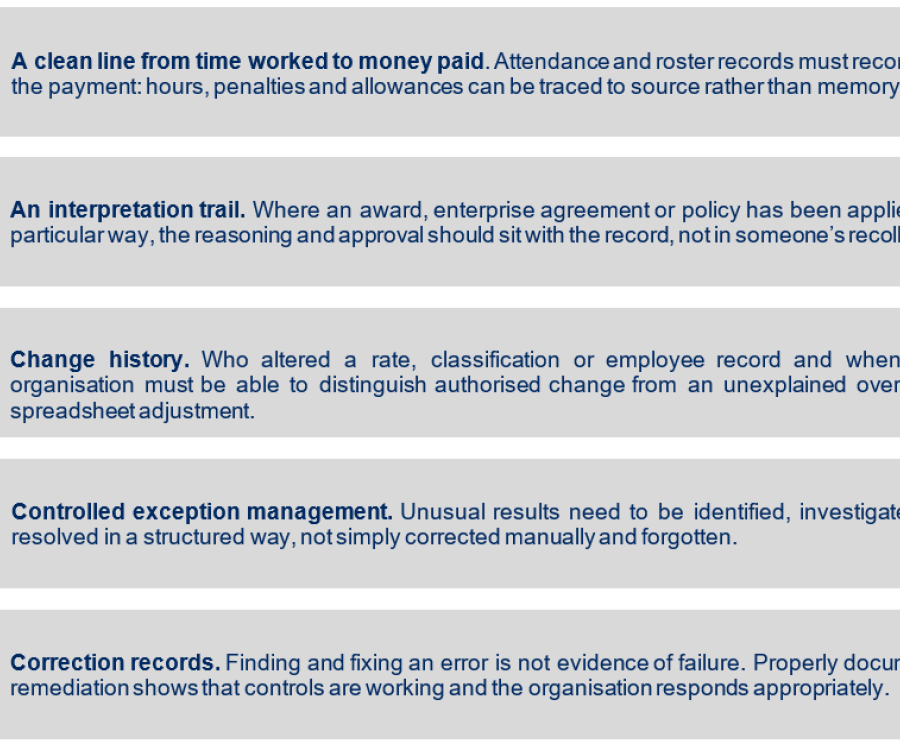
The audit trail is no longer something payroll keeps for the auditor. It is how payroll demonstrates control.
Payroll Compliance Starts Before Payroll
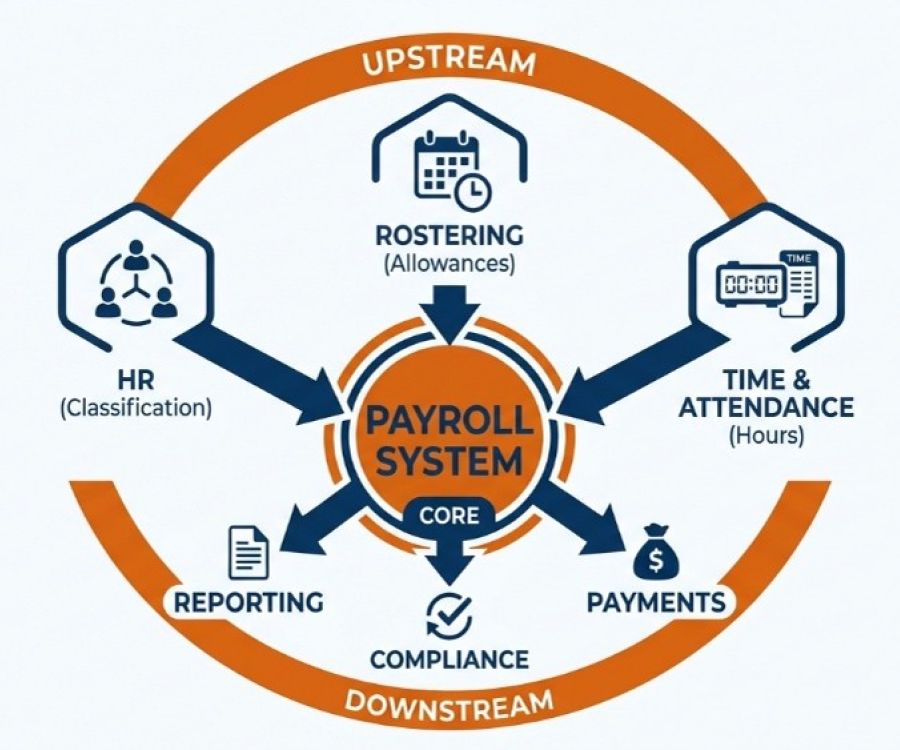
Some of the most important payroll controls sit outside the payroll function.
An incorrect classification may begin in HR. A missing allowance may originate in a roster. An incorrect hours record may come from a time-and-attendance system. An informal bank detail change can arrive too late to leave a clear trail. By the time the issue reaches payroll, the original decision is often hard to reconstruct.
Upstream data quality is therefore a payroll compliance issue. The more systems, spreadsheets, manual approvals and hand-offs involved, the harder it becomes to establish a complete evidence trail. Integration helps only when systems preserve the information needed to understand what happened.
For payroll leaders, the useful question is no longer simply, “Did the system process the pay correctly?” It is, “Could we explain and evidence the entire chain that produced this result?”
A Responsibility That Reaches the Boardroom
Criminal underpayment provisions and heightened superannuation scrutiny mean payroll compliance is no longer contained within the payroll team.
Who has a stake in whether a pay decision can be defended
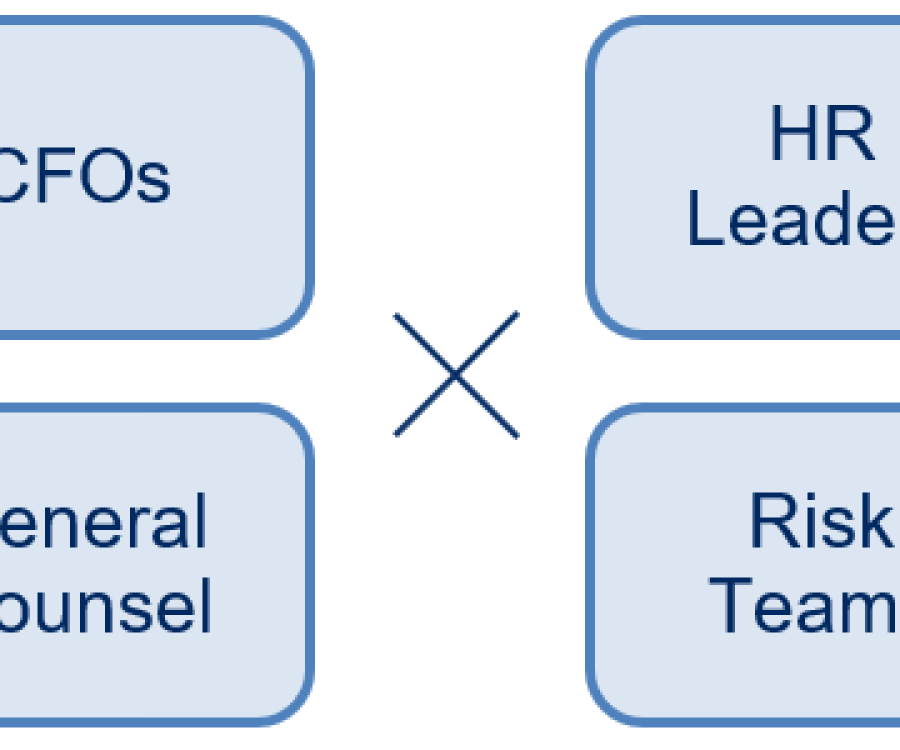
Payroll evidence provides executives with a direct view into the organisation’s control environment: whether governance is effective, risk exposure is understood, records are ready for scrutiny and issues can be identified and resolved before they carry wider consequences. A clear, traceable record strengthens audit readiness, supports informed oversight and helps protect the organisation’s reputation when payroll decisions are questioned.
For boards and executive teams, payroll evidence is therefore a practical measure of operating control. When an organisation can show how source data entered the process, how rules were interpreted, who approved decisions, how exceptions were managed and how corrections were made, it can demonstrate that payroll risk is being governed with appropriate rigour.
Payday Super Is an Evidence Test in Disguise
It is tempting to treat Payday Super as a pure timing challenge. The first year of the regime, however, places greater weight on the quality of processes, controls and records.
The ATO’s PCG 2026/1 sets out its compliance approach and recognises factors such as an employer’s efforts to comply and its response when problems arise. The quality of evidence therefore becomes central when explaining what happened and what was done to fix it.
Payroll teams should ask whether they can demonstrate the end-to-end process from calculation to super contribution, identify exceptions, reconcile outcomes and retain the information needed to investigate a failure. The first year is an opportunity to build that capability rather than simply survive the change.
Building An Evidence-Ready Payroll
The evidence standard does not demand an entirely new discipline. Its foundations are familiar.
Start upstream with controls over employee and payroll data. Make approvals structured and visible. Establish clear ownership for exceptions. Preserve change history instead of overwriting records. Make corrections traceable. Ensure payroll, HR, rostering and finance systems can deliver a coherent record of what happened.
The Payroll Readiness Test
Four questions provide a practical test:
- Can you trace it? Can a payment be traced to the underlying time, attendance, leave, allowance or employee record?
- Can you explain it? Can someone see why the employee was paid that amount and which rule or interpretation applied?
- Can you see what changed? Can you identify changes to rates, classifications, employee records or configuration, including who made them and when?
- Can you show how you fixed it? If an error occurred, can you demonstrate when it was identified, how it was assessed and corrected, and what was done to prevent recurrence?
These are not merely audit questions. They are questions of payroll control.
Where To Start
A practical starting point is to apply the Payroll Evidence Readiness Test to a recent pay run, adjustment or correction. Follow the decision from its source through calculation, approval and payment, then assess whether someone outside the payroll team could understand what happened and why. Any break in that chain provides a clear priority for strengthening data, controls or record-keeping.