

Beyond Compliance: The Payslip as a Trust Signal
There is a moment every payroll leader will recognise. An employee approaches HR. Not angry but unsettled. Their pay is wrong again. It might be a missed shift allowance, overtime that didn’t reflect a roster change, or a leave deduction that doesn’t align with what the time management system shows. They can’t fully explain exactly what failed in the process. What they know is simpler: the organisation they gave forty-eight hours to last fortnight didn’t pay them correctly.

For many Australian organisations, these moments are becoming more frequent. The reason sits in the environment payroll now operates within. The Fair Work Commission administers more than one hundred Modern Awards, each defining pay rates, penalties, overtime thresholds and allowances by industry and role. More than 2.7 million employees are directly covered by these instruments. Shift loadings vary by time and day. Overtime may be calculated daily, weekly, or both. Annualised salaries require reconciliation against actual hours worked. The rules are precise. They change regularly. And they apply differently across almost every workforce configuration. Against this backdrop, enforcement has intensified:
$473MUnderpayments RecoveredRecovered by the Fair Work Ombudsman in the 2023/24 financial year. | $1.5BThree-Year TotalCumulative underpayments recovered over three years, contributing to a landmark enforcement period. |
High-profile cases involving large employers have reinforced what payroll professionals already know: complexity does not excuse error. Since January 2025, intentional wage underpayment has been a criminal offence. Accountability now extends beyond corporate penalties. But compliance is only part of the story.
What An Incorrect Payslip Does to The Person Receiving It
The more consequential issue is how an incorrect payslip is experienced. Employees do not experience payroll as a system. They experience it as an outcome. When that outcome does not reflect the hours they worked or the conditions they believe apply, a judgement forms. Quietly at first, but consistently. Over time, confidence gives way to doubt.
The Trust Dimension
The Australian Payroll Association has identified employee trust as one of the most significant, and least visible, consequences of systemic payroll error (Australian Payroll Association, 2025). This is not about satisfaction scores. It is about reliability.
The Cost of Doubt
Workforce research continues to show that the cost of voluntary turnover, particularly in experienced roles, extends well beyond the vacancy itself (AHRI, 2024). Payroll inaccuracies rarely present as the stated reason for leaving, but they shape how employees judge the organisation's consistency and fairness.
The issue isn’t simply whether payroll is compliant. It’s whether it is dependable.
Where The Problem Actually Sits
For many organisations, the problem doesn’t originate with payroll itself. It sits in the connection between time capture and pay calculation.
Time data is often captured in one system, reviewed or adjusted in another, and transferred into payroll. Even where integrations exist, they’re not always real-time, and they don’t always carry enough context for accurate interpretation. Each step introduces the possibility of inconsistency.
A correct shift allowance depends on how clocking data is interpreted.
Overtime depends on how thresholds are applied.
Leave depends on how recorded time aligns with entitlements.
When systems aren’t operating from a shared, live data set, discrepancies aren’t unusual. They’re expected.
Normalised Workarounds and False Confidence
The gap rarely presents as a visible failure. Instead, it shows up in patterns that become normal. Adjustments are processed every pay cycle and treated as routine. Supervisors correct or approve time data before payroll receives it. Employees query allowances or penalties rather than base pay. Payroll teams run parallel checks outside the system to validate outcomes. These behaviours keep payroll running. But they also signal something important: time and payroll are not operating from the same version of truth. This creates a form of false confidence.
Data moves between systems. Files are exported, uploaded, and processed. From a distance, this can look like integration. But movement is not alignment.
The critical question is whether the interpretation of data remains consistent at every point. If time is captured one way, adjusted another, and calculated differently again in payroll, the final outcome may still rely on manual intervention. Even when well-controlled, intervention introduces variability.
And employees notice that variability.
What Changes When Time and Payroll Truly Align?
Organisations that move towards an integrated model (where time and payroll operate from a shared, real-time data set) often describe a shift that’s less about efficiency and more about consistency.
Award interpretation is applied at the point of time capture rather than retrospectively. Overtime triggers, allowances and leave accruals are calculated from the same data set visible to managers, employees and payroll. Exceptions are identified before a pay run is finalised, not after a payslip is issued. The result isn’t just fewer errors. It’s fewer surprises. Errors can be corrected. Surprises erode confidence.
Regulatory Pressure Is Accelerating the Issue
Regulatory change is increasing the pressure to achieve this level of consistency. From 1 July 2026, the Australian Taxation Office’s Payday Super reforms will require superannuation to be remitted with every pay run rather than quarterly. This creates a direct dependency between recorded time, payroll calculations and statutory remittance. Delayed transfers and manual hand-offs between systems become harder to sustain.
Industry commentary reflects this shift. Accuracy is assumed. Proof is required
For payroll teams, that means being able to trace outcomes back to source data with confidence. For employees, it means receiving a payslip that matches the hours they know they worked.
Assessing Whether the Gap Exists
A more practical way to assess the issue is to stop looking at systems and start looking at outcomes.
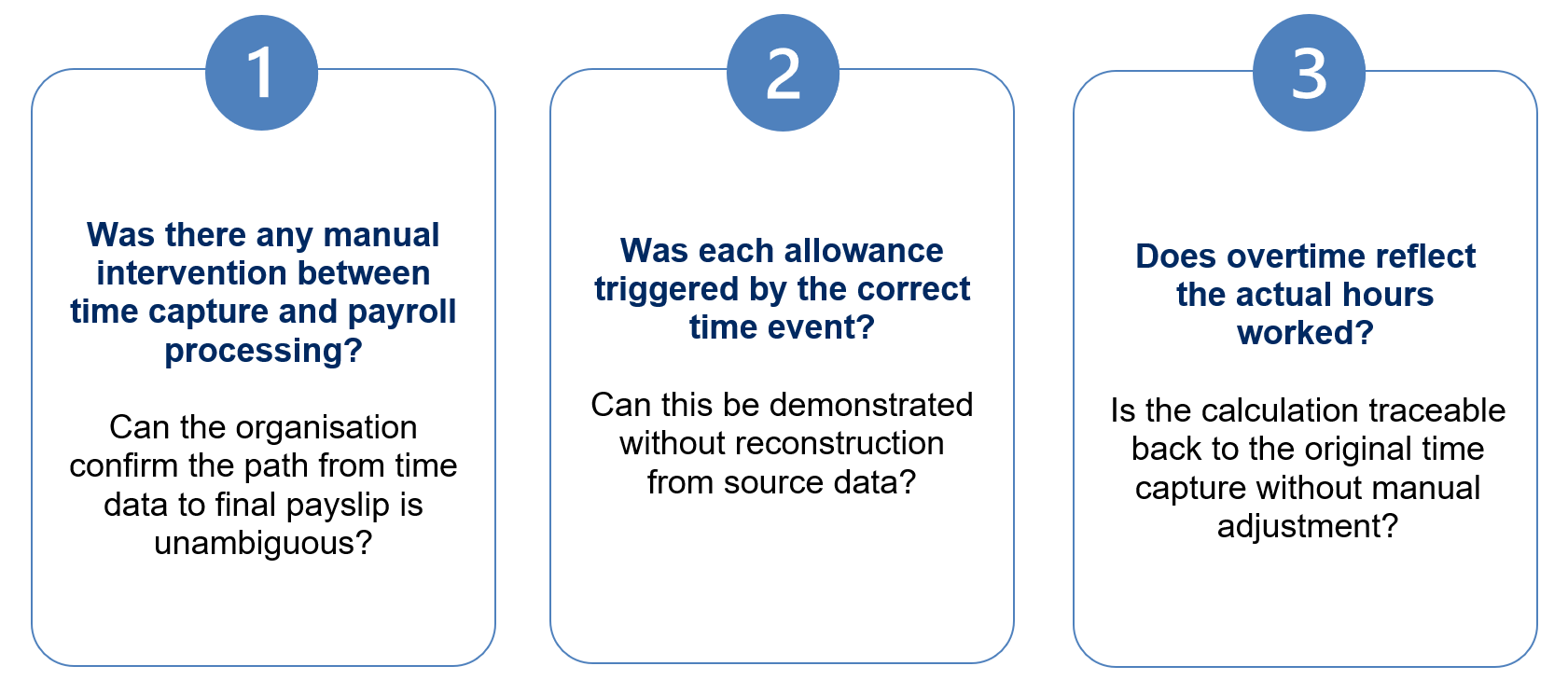
If an employee questioned their most recent payslip, could the organisation demonstrate (without reconstruction) that:
no manual intervention altered the result between time capture and payroll processing
each allowance was triggered by the correct time event
overtime reflects the actual hours worked, with calculations traceable back to source data
In many organisations, answering these questions requires investigation. Data must be reconciled across systems. Adjustments must be explained. The final figure may be correct, but the path to it is rarely simple. That lack of clarity is where the gap becomes visible. It is also where perception forms.
Employees don’t see systems or processes. They see outcomes. When those outcomes are consistently dependable, trust builds quietly. When they’re not, doubt does the same.
Closing The Gap Really Takes
Closing the gap is often framed as a technology decision. Technology matters, but it isn’t the starting point.
Payroll is the final expression of multiple upstream processes. Time capture, roster design, approvals, and system configuration all shape the result an employee receives. Misalignment at any point introduces variability at the end.
Reducing that variability requires fewer points of interpretation. The less often data is adjusted, reinterpreted, or transferred, the more consistent the outcome becomes. Real-time integration supports this, but so does clarity in rules, ownership and exception handling.
Change management plays a role too. Integrated models change how managers interact with time data, how payroll teams manage exceptions, and how employees engage with their own records.
Organisations that address the issue holistically tend to see the benefits beyond reduced error rates. Queries decline. Confidence grows. Payroll becomes less visible as a problem and more reliable as a function.
In a complex regulatory environment, accuracy will always matter. But accuracy alone isn’t what employees experience.
They experience whether the outcome can be relied upon.
In that sense, the payslip is more than a record. It’s a reflection of how consistently an organisation translates time into value.
The question is no longer whether the gap exists. It’s how visible is it, and how long it can remain that way.