

Living with the System: The Real Truth of HR Technology Investment
Ask a payroll manager how the new HR system is going and the response is rarely enthusiastic. There is usually a pause (brief but telling) followed by a neutral answer. “It works.” No excitement. No pride. Just a quiet acceptance that payroll runs, people get paid and the wheels keep turning. That response says more that it seems.
When “It Works” Isn’t Enough
When someone says a system “works”, they usually mean it meets the minimum requirements. Payroll processes complete. Reports generate. Critical failures are rare.
What they don’t say (but everyone understands) is what sits underneath.
Spreadsheets remain long after they were meant to disappear. Manual reviews fill gaps no one expected. Certain calculations only land cleanly when the right person happens to be at the keyboard. Knowledge becomes personal rather than shared.
None of this featured in the original business case. None of it appeared during system demonstrations.
It only emerges later, once go-live has passed, the project team has moved on, and the organisation is left to live with the system day after day.
This gap between promise and reality is now shaping how Australian organisations think about HR technology. The conversation is shifting away from feature depth and raw capability and toward something more pragmatic. Not what a system can do at its best, but how it behaves over time, under ordinary pressure, with ordinary people.
Cost Doesn’t Blow Out. It Creeps.
At signing, the numbers are neat. A licence fee. An implementation budget. A defined scope.
Approval flows. Projects commence. Confidence is high. A small integration here. A configuration change there. Support hours that stretch slightly longer each time.
Individually, each decision makes sense. Together, they quietly change behaviour. Teams hesitate before requesting improvements. Sensible ideas sit untouched because the effort no longer feels worth it.
Research from Gartner and Deloitte continues to highlight total cost of ownership as a persistent challenge in enterprise technology. But the real impact shows up on an ordinary Tuesday afternoon, someone decides not to fix something because it feels harder than it should.
Complexity Builds One Sensible Decision at a Time
Complexity grows quietly alongside cost. It rarely arrives through recklessness. Instead, it accumulates through reasonable choices:
an integration to close a genuine gap
a configuration tweak to support a business rule
a manual workaround to get through a tight timeframe
Taken separately, each choice makes sense. Taken together, they create an environment that feels dense, fragile, and hard to navigate.
System knowledge becomes fragmented. Some sits with the vendor. Some lives in internal documents that haven’t been opened in months. The rest resides with individuals until they move on.
When something breaks, the first question is no longer what went wrong. It’s where to start looking.
In payroll and HR, this matters more than most. Accuracy isn’t optional. Mistakes move quickly from inconvenience to consequence:
compliance issues
back payments
frustrated employees
Complexity doesn’t live inside technology alone. It sits at the intersection of systems, people, and process. And payroll sits directly at that intersection.
Configuration Helps, Until It Doesn’t
Configurable platforms deliver real value. They allow organisations to reflect awards, agreements, structures, and approval flows without starting from scratch. For Australian employers navigating layers of awards and employment types, some tailoring is essential.
The problem isn’t configuration itself. It’s what happens when configurations compound.
Over time, upgrades shift from welcome improvements to carefully managed events. Testing cycles stretch.
Documentation falls behind reality. The number of people who truly understand how everything fits together starts to shrink.
Slowly, the relationship reverses.
What began as the system serving the business, becomes the business shaping itself around the system.
Payroll Feels It First
Payroll teams experience these changes earlier than most.
Payroll runs on fixed cycles. It must be right every time. When systems become harder to adjust or less transparent, behaviour adapts quietly, without announcements or escalation.
Extra checks appear. Manual reviews increase. Dependence on key individuals grows.
None of this looks like failure. It just feels harder than it should.
Confidence shifts away from the system and toward whoever happens to be available and knowledgeable at the time.
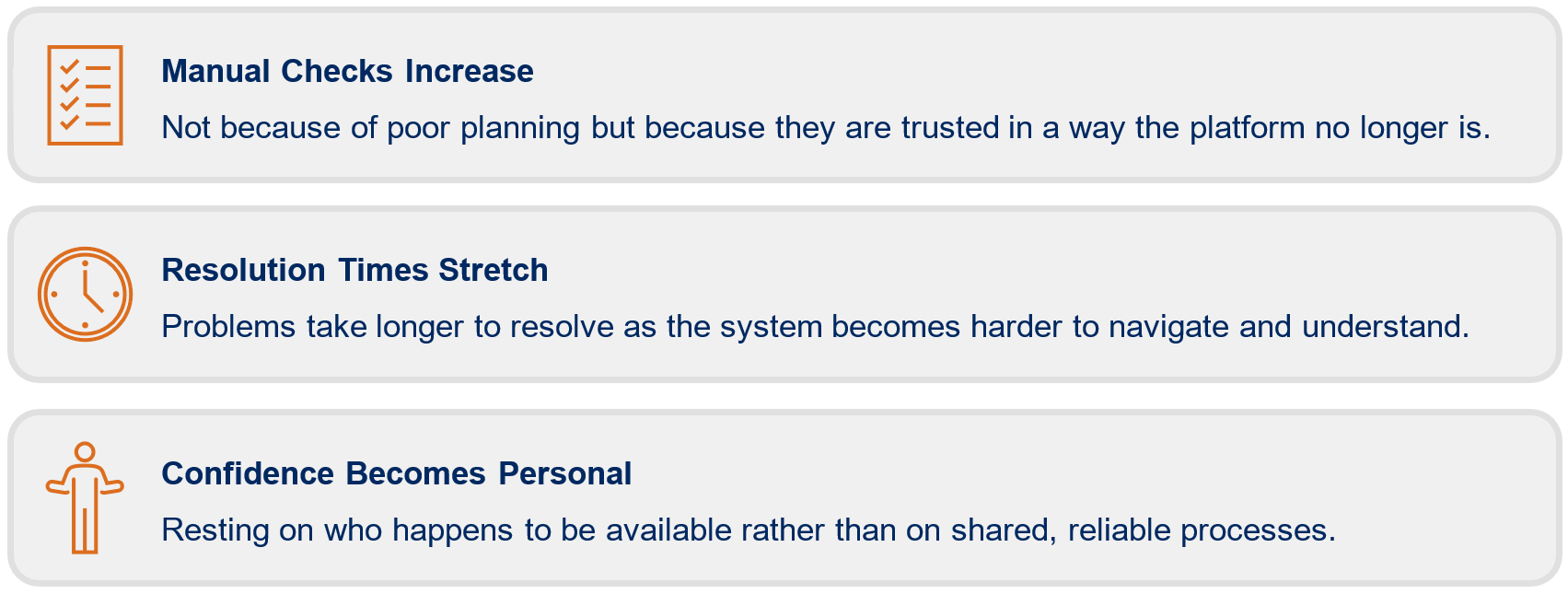
None of this usually looks like failure. It simply feels like effort. Extra steps. A cautious atmosphere. A growing dependence on key individuals rather than the environment itself.
The Question No One Asks at Purchase Time
The frustration lies in how invisible this problem is at the point of purchase.
Business cases focus on capability and projected returns. Implementation plans define timelines, milestones and training sessions. Rarely does anyone ask how the system will behave three years on, after staff turnover, organisational change and countless small adjustments no forecast ever captured.
The result is not buyer error. It is a blind spot built into how organisations evaluate technology.
Organisations That Handle This Better
Some organisations navigate this better than others. They do this not by avoiding complexity, but by managing it deliberately. They are:
Deliberate about customisation, applying it where it delivers clear, lasting value.
Focused beyond go-live, planning for maintenance by people who were never in the original room.
Invested in internal capability, rather than permanent external dependence.
Intentional about knowledge, treating it as an asset rather than tribal memory.
Complexity doesn’t disappear. Nor should it. Real organisations aren’t simple. What changes is the character of that complexity.
Problems are easier to locate. Adjustments flow more smoothly. Confidence becomes organisational rather than personal.
Across the market, this shift is already visible. Some organisations are simplifying and stabilising what they have. Others are reconsidering whether their current platform remains the right foundation for the years ahead.
In both cases, the emphasis is the same. Systems stay understandable, maintainable and resilient long after go-live.
The Measure That Matters Most
HR technology is never a one-off decision. It is a set of conditions that unfolds over years.
Costs evolve. Complexity accumulates. Customisation deepens its influence.
The systems that create lasting value are rarely those with the longest feature lists or the most flexible architectures. They are the ones organisations can operate with quiet confidence, adapt without drama, explain without hesitation and rely on without workarounds.
That is a different measure from capability alone. And it’s the one that matters most once the honeymoon ends and the real work begins.