

From Contingent to Connected: Why HR Must Lead the Extended Workforce
Walk through most mid-to-large Australian organisations and you will find the same quiet contradiction. The org chart describes a workforce of permanent employees, reporting lines and neatly defined roles, while the actual workforce looks considerably more complex: contractors embedded in project teams for months at a stretch, labour hire workers operating alongside permanent staff under shared management, and specialist consultants engaged on statements of work, technically employed by someone else but functionally indistinguishable from the broader team.
This has been the operating reality of Australian industry for the better part of a decade, and it is consolidating rather than receding. What represents the clearest opportunity for most organisations is the management infrastructure around it.
The dominant conversation defaults to compliance, and understandably so. Classification risk under the Fair Work Act, superannuation obligations, payroll tax exposure, and the evolving legal treatment of casual and gig workers are legitimate concerns. The broader opportunity is treating the extended workforce as a standalone workforce strategy question. Compliance defines the boundary conditions; the more rewarding work is designing the workforce model that performs within them.
The Visibility Opportunity: A Single Source of Truth for the Total Workforce
The more fundamental issue is visibility, and it rarely surfaces in the compliance conversation. Ask most HR leaders for a complete picture of their total workforce and there is genuine complexity to navigate.
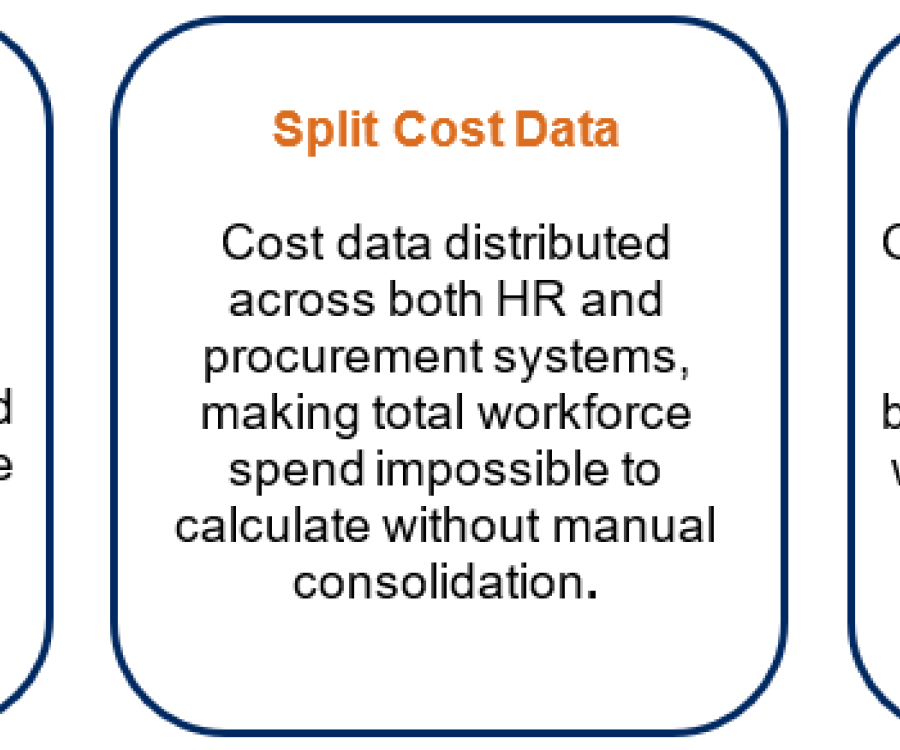
This fragmentation reflects the way contingent labour has historically been managed in Australian organisations, as a procurement activity rather than a workforce activity. A business unit needed a resource; procurement engaged a supplier; the worker arrived; and HR found out about it, if they did at all, well after the engagement was underway. That model made sense when contingent labour was occasional and peripheral, but it makes less sense when contractors, labour hire and contingent workers represent a meaningful share of those doing the actual work of the organisation.
The proportion of the workforce operating outside traditional employment arrangements continues to grow across professional services, construction, technology and healthcare, and the management frameworks in place across most organisations have a genuine opportunity to evolve alongside it.
Managing Operational Risk: Systems, Payroll, and People
Organisations that move beyond managing the workforce as isolated procurement transactions find meaningful improvements in HRIS, payroll and IT security operations.
Payroll Tax Exposure
For payroll leaders specifically, the exposure is direct. Under Australian harmonised payroll tax legislation, payments made to contractors may be deemed wages if the engagement falls under a relevant contract, broadly meaning the contract is predominantly for the worker’s labour. Excluding these payments from payroll tax liability requires the payroll team to actively demonstrate that specific statutory exemptions apply, such as the contractor providing services for 90 days or fewer in a financial year.
Offboarding Controls
Offboarding controls are an equally important consideration. Without automated, system-driven processes linked to a centralised HR database, maintaining clear offboarding records tied to a centralised HR database ensures that network access, corporate data and physical credentials are deactivated at the right time, closing a gap that better data architecture resolves simply and reliably.
Cultural Integration
There is also a cultural dimension that organisations tend to underestimate. Contingent workers who are included in structured onboarding, receive meaningful feedback, and are integrated into the teams they work alongside tend to be more productive and more engaged. The downstream benefits, including stronger project velocity, better team cohesion and a more attractive employer brand for contingent talent, are real and measurable.
When contractor data sits in procurement spreadsheets or external vendor portals rather than a central system, calculating accurate payroll tax exposure and maintaining audit-ready records requires the kind of consolidated workforce data architecture that centralised management makes easy.
What Structured Environments Get Right
There are settings in Australia where this has been addressed more deliberately. The NSW Government’s Contractor Central framework and Queensland’s contingent workforce arrangements under Buy for Queensland both demonstrate what centralised visibility looks like in practice:
Defined engagement frameworks,
Consistent onboarding and compliance controls
consolidated reporting that supports planning
The procurement mechanics differ from those of a commercial organisation, but the underlying logic transfers readily. Contingent workforce engagement, when it sits within a defined framework with clear governance, consistently generates better data, better compliance outcomes and better planning capability than decentralised, reactive engagement managed differently across every business unit.
Why This Sits in HR, Not Procurement
There is both a governance case and a strategic case for HR taking genuine ownership of the extended workforce.
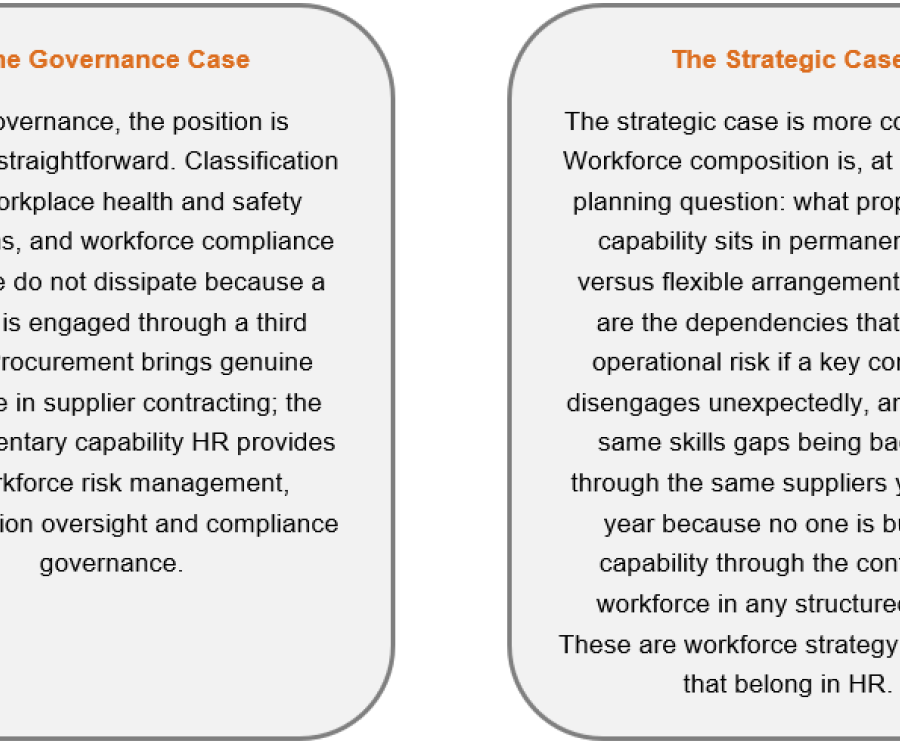
The Chartered Institute of Personnel and Development has consistently identified workforce planning as a core strategic HR capability, noting that organisations with mature planning capability are measurably better positioned to respond to skills volatility and structural change (CIPD, 2024).
An extended workforce sitting entirely outside that planning process represents a genuine capability gap, regardless of how well the supplier contracts are managed.
The Technology Question, Framed Correctly
Most organisations sit somewhere along a workforce maturity spectrum. At one end, contingent hiring responds to immediate operational need; at the other, workforce data across all engagement types actively supports planning, forecasting and risk management. Moving along that spectrum is, in the first instance, an ownership and governance challenge rather than a technology one. Organisations that settle the governance question first find the technology layer becomes far more tractable. Industry research points to a clear shift in workforce technology toward unified analytics and planning capability across labour types. What technology then needs to deliver is well understood: accurate worker data from the point of engagement, consistent compliance controls, and consolidated reporting that makes workforce planning genuinely useful. Clean data and reliable reporting depend on consistent process, not platform sophistication.
The Decision That Changes the Trajectory
The organisations best placed to manage workforce cost, capability and risk are those that have made a deliberate decision to treat the extended workforce as a single managed system: defined ownership, consistent process, and data genuinely usable for planning. Practical starting points include a contingent workforce audit to establish baseline visibility, defining cross-functional governance with procurement, and piloting integrated reporting for key business units. The strategic logic is clear, the tools exist, and the governance can be designed. The organisations that move first will be better positioned on cost, capability and risk.