

Beyond Headcount: Why Workforce Visibility is Becoming Essential to Strategic Workforce Planning
Organisations are making consequential decisions about workforce investment, cost and capability without a complete view of who is doing the work. They may know how many people they employ, yet remain unclear about the full cost of the workforce delivering their outcomes, where critical capability sits, which functions depend on external expertise and where that dependency creates risk.
The workforce itself has moved well beyond the boundaries of the organisational chart. Permanent employees now work alongside labour hire workers, contractors, outsourced providers and consultants, with each contributing skills and capacity that may be essential to delivery. At the same time, hybrid work and digital transformation continue to reshape where work happens and the capabilities organisations need.
Most organisations hold extensive workforce data, but comparatively little workforce visibility. Information is dispersed across HR, payroll, workforce management, procurement, finance and operational systems, leaving decision-makers with separate views of people, time, cost and capability. Without a connected picture, organisations risk recruiting capability they already possess, underestimating their reliance on contingent workers and directing workforce investment towards an incomplete understanding of current and future needs.
Why Headcount Reporting Is No Longer Enough for Strategic Workforce Planning
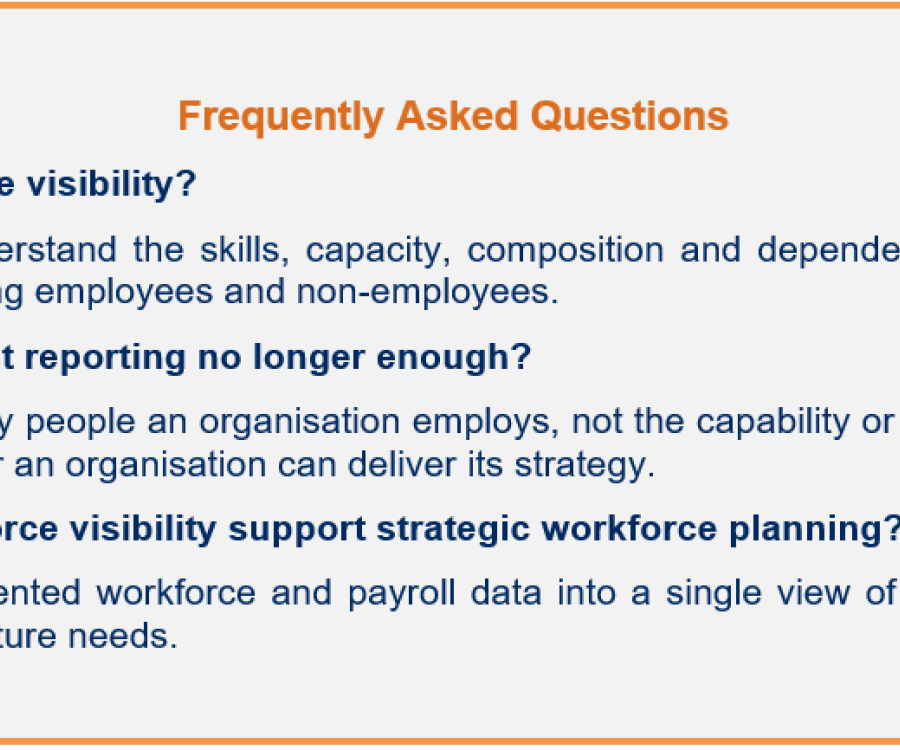
Headcount tells organisations how many people they employ; workforce visibility explains what that workforce can achieve. The limits of headcount become apparent when organisations try to connect workforce numbers with business performance. A division may employ 250 people, but that figure says little about whether it has the skills and capacity to deliver its priorities, how effectively its workforce is being utilised or where capability depends on people outside the permanent workforce.
The answers often exist across the organisation, just not in the same view. Payroll, HCM and workforce management data may reflect employees, labour costs, organisational structures, rosters, time and attendance, while procurement and finance capture significant expenditure on contractors, consultants and outsourced services. When these sources remain disconnected, executives cannot readily see the relationship between workforce cost, utilisation, capability and risk.
This fragmentation matters because critical capability frequently sits beyond direct employment.
Contractors may maintain essential technology platforms.
External specialists may deliver major transformation programs.
Consultants may provide expertise that has not yet been developed internally. Their contribution can be integral to performance, yet remain absent from the workforce picture used to inform planning and investment.
Strategic workforce planning increasingly requires organisations to look across the entire workforce, connecting skills with roles, cost with capability and future demand with current capacity. This reflects a broader move towards skills-based planning, where capability is understood by what people can contribute rather than employment status or position title alone. As the Australian Public Service Commission has emphasised, strategic workforce planning helps organisations build the capability required to meet future demand, rather than simply respond to immediate staffing gaps.
The Hidden Cost of Poor Workforce Visibility
Poor workforce visibility rarely attracts attention until something goes wrong: a critical project stalls when a specialist contractor departs, or recruitment begins for skills that already exist elsewhere.

Without a comprehensive view of workforce capability, leaders often make decisions based on incomplete information: recruitment may overlook internal mobility, and managers can struggle to balance workloads because they cannot see where capacity exists elsewhere. Recruiting externally for scarce capability is often more expensive than developing existing talent, yet organisations cannot make that call without knowing what skills they already have.
The Australian Bureau of Statistics highlights the diversity of Australia's labour market, with employment increasingly encompassing arrangements beyond permanent work. The Fair Work Ombudsman now recognises multiple categories of employment relationship. As these categories grow more complex, the strategic risk extends beyond compliance, into the blind spots that complexity creates around workforce capability.
Why Leading Organisations Are Changing the Conversation
Some organisations already treat workforce understanding as a strategic capability rather than an administrative exercise. Australia Post is an example of how workforce capability investment must connect to long-term transformation: its 2024 Annual Report describes investment in:
→ leadership capability
→ digital skills
→ workforce planning
→ organisational development.
Which all linked directly to performance, growth and the ability to adapt to changing market conditions.
This reflects a broader shift. The Australian HR Institute's research consistently identifies strategic workforce planning, workforce capability and people analytics as priorities for senior HR leaders, as organisations increasingly see understanding their workforce as a competitive advantage.
What Workforce Visibility Means for Organisational Leadership
Workforce visibility is often associated with dashboards and reporting, but its value extends well beyond either. It gives leaders across HR, Payroll, Finance and the executive team a shared understanding of the capability, capacity, cost and composition of the workforce underpinning organisational performance.
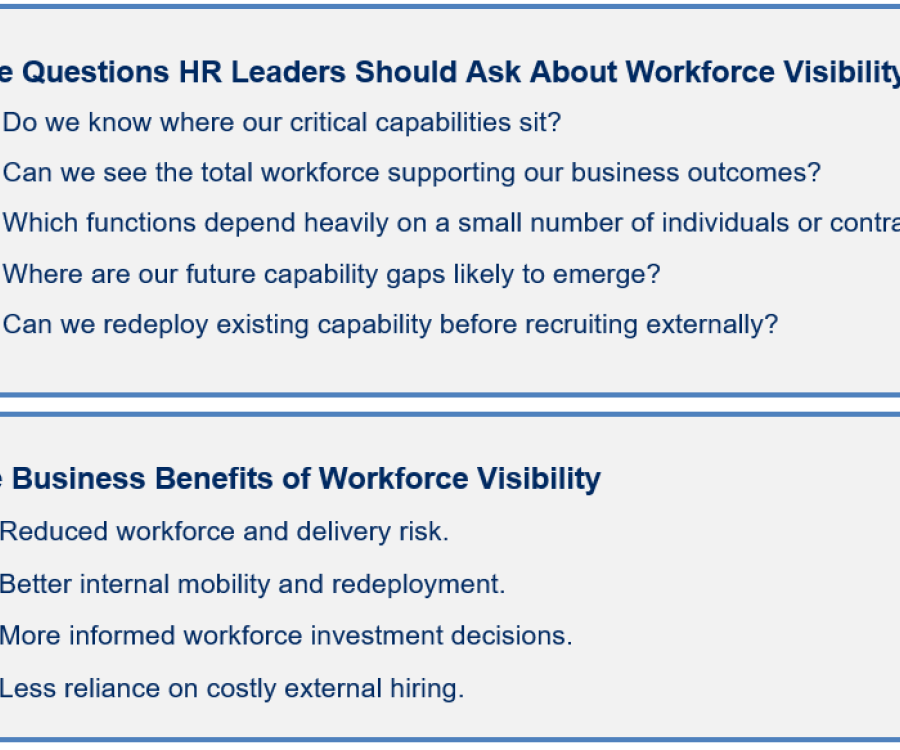
That means being able to answer questions with consequences across the business:
Where do critical skills reside?
How is capability distributed across business units?
Where do workforce dependencies create operational or financial risk?
Which functions rely heavily on a small number of employees, contractors or external specialists?
Are succession pipelines keeping pace with future capability needs, and does workforce investment align with organisational strategy?
These questions apply to the entire workforce, including permanent employees, contractors, labour hire workers, consultants and outsourced providers. Planning around only those captured in traditional employee reporting leaves material contributions, costs and dependencies outside the frame.
Workforce and people analytics can surface patterns such as capability gaps, constrained capacity and emerging workforce risk. Their value, however, depends on the information available to them. When HR, Payroll, workforce management, procurement and finance data remains disconnected, each function sees a different part of the workforce. Bringing those views together gives decision-makers a clearer basis for assessing workforce cost, utilisation, capability and risk. Technology enables that connection; the strategic value comes from the decisions it informs.
How HR Leaders Turn Workforce Data into Strategic Workforce Intelligence
Most organisations do not lack workforce data. Employee records, payroll information, recruitment metrics, procurement records and operational insight into project delivery already exist; the challenge is that these sources tell separate stories.
Workforce visibility brings those stories together, shifting discussions from historical reporting towards future planning: where capability gaps are likely to emerge, which roles are becoming harder to recruit, and where to invest in internal capability rather than buying expertise externally. These questions underpin effective strategic workforce planning and show why it has become a business capability shaping resilience and competitiveness, rather than remaining solely an HR concern.
Does your organisation truly understand the workforce delivering its outcomes today? For many, the honest answer is that they understand their employees far better than they understand their workforce.
Organisations increasingly deliver value through a complex mix of permanent employees, contingent workers and external partners. Managing that complexity requires visibility across the people and capabilities that enable the organisation to achieve its objectives.
The next generation of workforce planning will be defined by better workforce intelligence, not better headcount reports. As skills shortages, transformation pressure and workforce complexity become permanent conditions, visibility is no longer a reporting advantage; it is a strategic requirement. HR has a genuine opportunity to lead that shift, helping executives make more informed decisions about growth, investment, succession and resilience. The organisations that outperform over the next decade will simply understand their workforce better. Headcount measures the size of a workforce; workforce visibility measures its value.