

The Accountability Gap: Why Australian Boards Lack True Payroll Certainty
The boardroom table of a modern Australian enterprise is a study in sophisticated oversight. Directors navigate the complex metrics of carbon reduction targets, geopolitical supply chain vulnerabilities and artificial intelligence integration. These high-stakes discussions are guided by mature reporting frameworks, clear definitions of materiality and established indicators of organisational risk.
Yet, when the agenda turns to payroll compliance, the discussion often shifts from strategic oversight to operational process. What should be a governance conversation can become a transactional check-box exercise.
This is a significant blind spot in modern governance. The legislative environment has transformed payroll compliance into a material board-level issue, yet the mechanisms through which Australian boards receive, interrogate and act on payroll data, have evolved more slowly.
Boards have heard the warnings that payroll is now a tier-one corporate risk. The challenge now is to convert that awareness into governance discipline. Directors often lack the reporting metrics, governance frameworks and shared language required, to evaluate payroll integrity effectively.
At the same time, payroll leaders are rarely expected to translate technical payroll realities into risk language that resonates at board level. The result is a growing disconnect between organisational exposure and board visibility, at a time when regulatory scrutiny is increasing.
The Changed Landscape: Personal Stakes and Director Scrutiny
This governance challenge has intensified due to Australia's evolving legislative environment. The criminalisation provisions governing industrial relations are now well established. Under the Fair Work Legislation Amendment (Closing Loopholes No. 2) Act 2024, intentional underpayment of wages became a federal criminal offence from 1 January 2025.
While most boards received compliance briefings when the legislation was introduced, attention has now shifted to execution. Directors must determine whether those briefings translated into permanent, systemic controls.
The personal consequences are clear. Under amendments to the Fair Work Act 2009, individuals found guilty of intentional wage theft face up to 10 years imprisonment and penalties of up to $1.565 million, or three times the underpayment amount, whichever is greater.
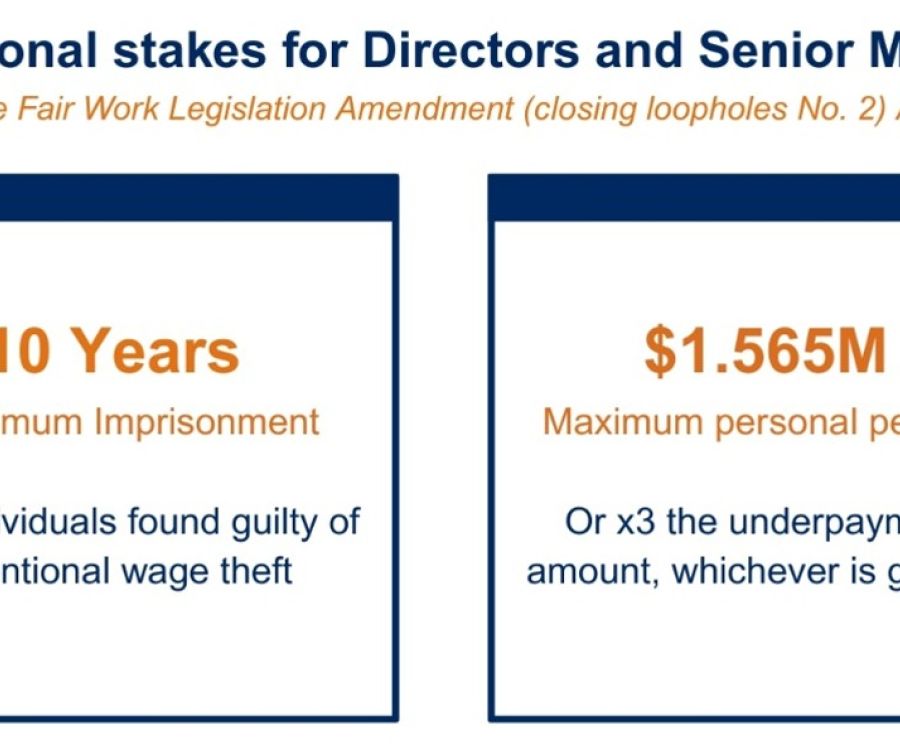
Payroll compliance is therefore no longer simply an administrative obligation. Thomson Reuters Legal Insight notes that directors and senior managers are likely to face close scrutiny in wage theft matters. Leaders must demonstrate that appropriate policies, controls and governance structures were in place to support compliance.
This scrutiny extends beyond payroll processing. Regulators may examine how organisations responded to historical discrepancies, whether payroll functions were adequately resourced and whether governance structures provided sufficient oversight. Decisions around payroll investment, systems and assurance processes may become central to assessing organisational conduct.
The Confidence Paradox: Rising Enforcement, Falling Certainty
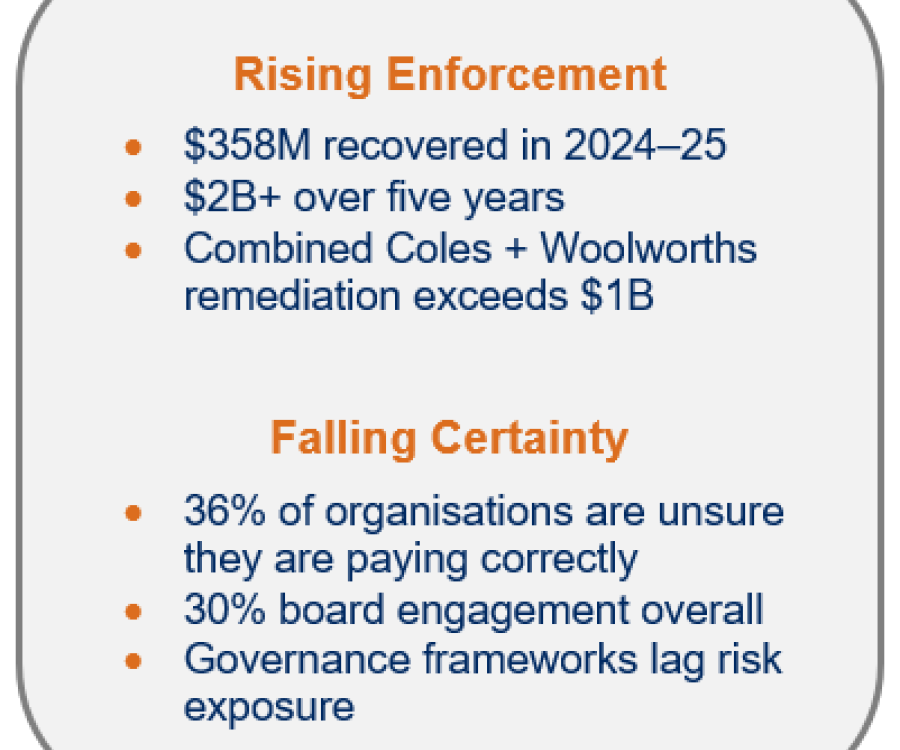
Recent data highlights a consistent pattern: increased board attention has not necessarily translated into confidence.
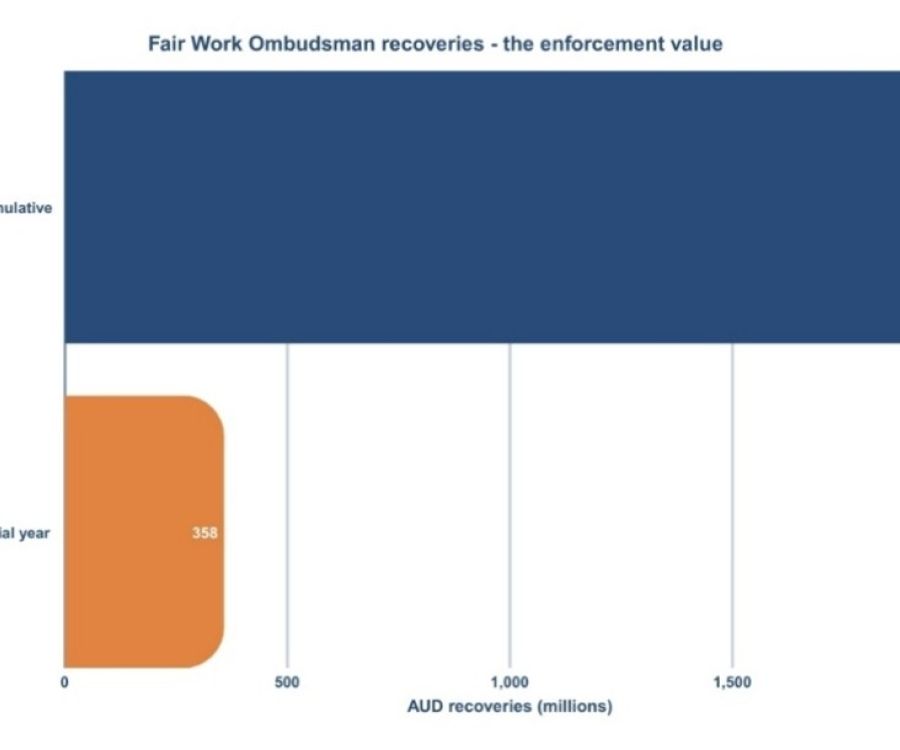
The Fair Work Ombudsman recovered $358 million for more than 249,000 underpaid workers during the 2024–25 fiscal year. This brings total recoveries to more than $2 billion over five years. Large employers accounted for approximately 60 per cent of recoveries, contributing almost $213 million. Regulatory pressure has encouraged closer scrutiny of payroll compliance. In doing so, many organisations have encountered complexity that challenges assumptions about payroll accuracy.
According to the 2026 State of Payroll Compliance Report, 36 per cent of Australian organisations remain unsure whether they are paying employees correctly. Board-level engagement in payroll reporting has increased to 30 per cent overall and 40 per cent among the largest employers. Even with greater oversight, confidence remains difficult to establish.
The scale of an organisation provides no protection against systemic payroll error. On 5 September 2025, the Federal Court found that Coles and Woolworths had underpaid thousands of salaried store managers under the General Retail Industry Award 2010. The Court found that reliance on annual salaries and set-off arrangements, failed to meet award obligations and criticised record-keeping practices. Combined remediation costs are expected to exceed $1 billion.
This challenge occurs alongside rising regulatory burden. Research by Mandala Partners and the Australian Institute of Company Directors (AICD) found compliance costs increased from $65 billion in 2013 to $160 billion in 2024. Board time devoted to compliance has more than doubled. Payroll compliance increasingly competes with other governance priorities despite its material risk profile.
The Cyber Comparison: Structured Oversight Gap
The gap in maturity becomes clearer when payroll governance is compared with cyber security. The Australian Signals Directorate (ASD) and AICD have produced guidance that gives directors structured questions and benchmarks to assess cyber resilience. This provides a consistent framework for evaluating technical risk. Payroll compliance has no equivalent governance framework.
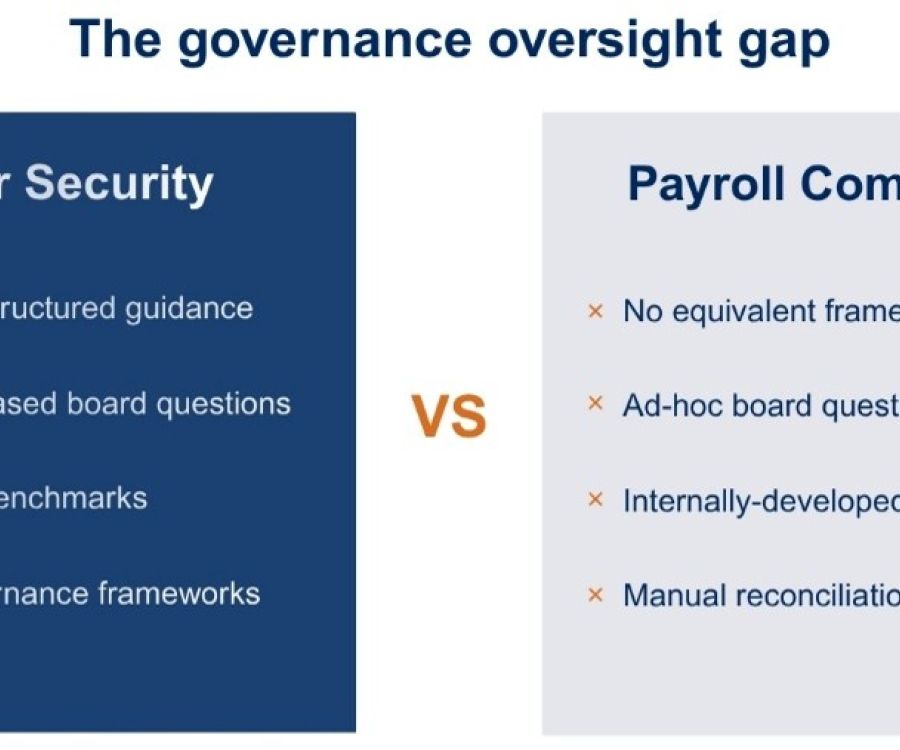
Boards can ask their Chief Information Security Officer structured, standards-based questions. Few organisations can do the same for payroll, despite its direct impact on financial integrity and regulatory exposure.
The AICD has acknowledged that traditional approaches such as manual reconciliation, periodic audits and siloed reporting no longer provide sufficient visibility for modern governance expectations. Effective oversight requires consistent, independent insight into payroll outcomes.
Three Areas for Governance Maturity
To strengthen payroll oversight, organisations must address three structural issues.
1. Strengthening Reporting Pathways
Payroll typically reports through finance or human resources. Both functions are essential, but neither naturally frames payroll as a governance risk with potential legal consequences. Finance prioritises cost; HR focuses on workforce outcomes. Risk signals can be diluted as they move upward.
2. The Need for Standardised Metrics
Financial and cyber risks benefit from established reporting standards. Payroll compliance does not. Many organisations therefore rely on internally developed measures of exposure, confidence and control effectiveness, limiting comparability and consistency.
3. Translating Payroll Expertise into Governance Insight
Payroll professionals hold deep technical expertise. However, governance reporting requires the ability to translate complex calculations into concise insights on exposure, control effectiveness and escalation pathways. This translation capability is becoming increasingly important.
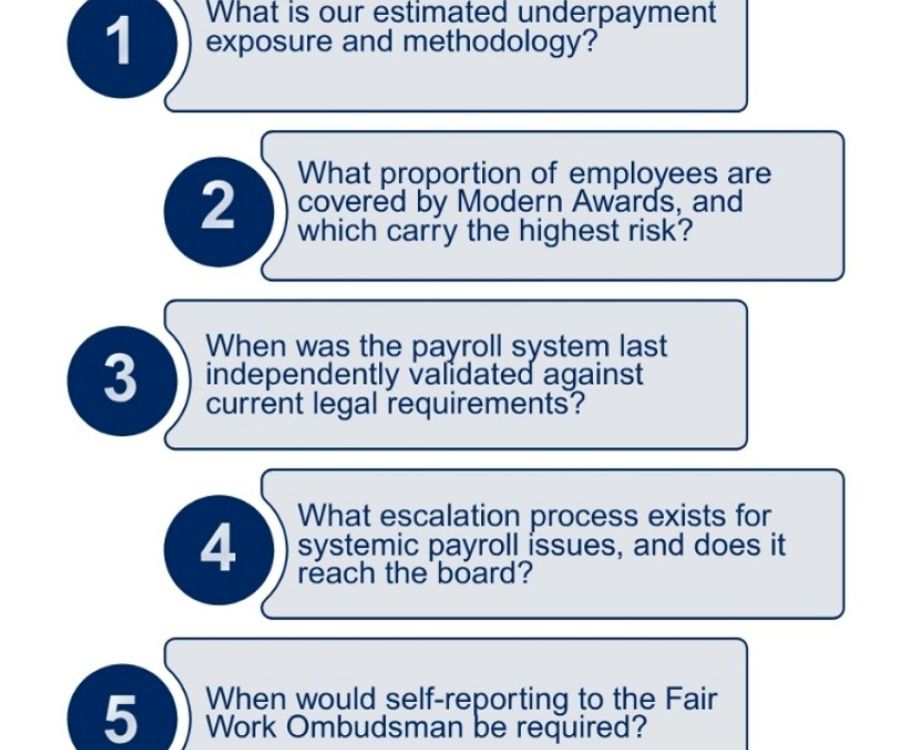
The Five Questions Directors Must Ask
To strengthen oversight, boards should expect clear, evidence-based answers to five questions:
The Next Stage of Payroll Governance
Payroll compliance is now firmly established as a board-level issue. Legislative reform, regulatory scrutiny and public visibility of underpayments ensure it can no longer be treated as an operational matter alone. The next stage is governance maturity.
Boards increasingly expect structured reporting, independent assurance and reliable visibility into material risk areas. Payroll is moving into that category. Organisations that lead will develop reporting disciplines, assurance mechanisms and governance frameworks that provide confidence rather than assumption.
For payroll leaders, this shift elevates the importance of translating operational complexity into governance insight. The ability to communicate exposure, control effectiveness and emerging risk in board-relevant language, is becoming a key leadership capability.
The question is no longer whether payroll matters - it is whether organisations have developed the governance structures required to oversee it effectively.
Those that do will be better positioned to provide boards with what they increasingly require: visibility, assurance and confidence.